
What is the poet’s intention in comparing the Egyptian queen to a serpent of old Nile or using hyperbole to describe the massive presence of Antony? You will also need to analyse the use of metaphor and dramatic irony to pass the Antony And Cleopatra Literary Devices Quiz. Look at the rhetorical devices that make this historical tragedy cosmic.

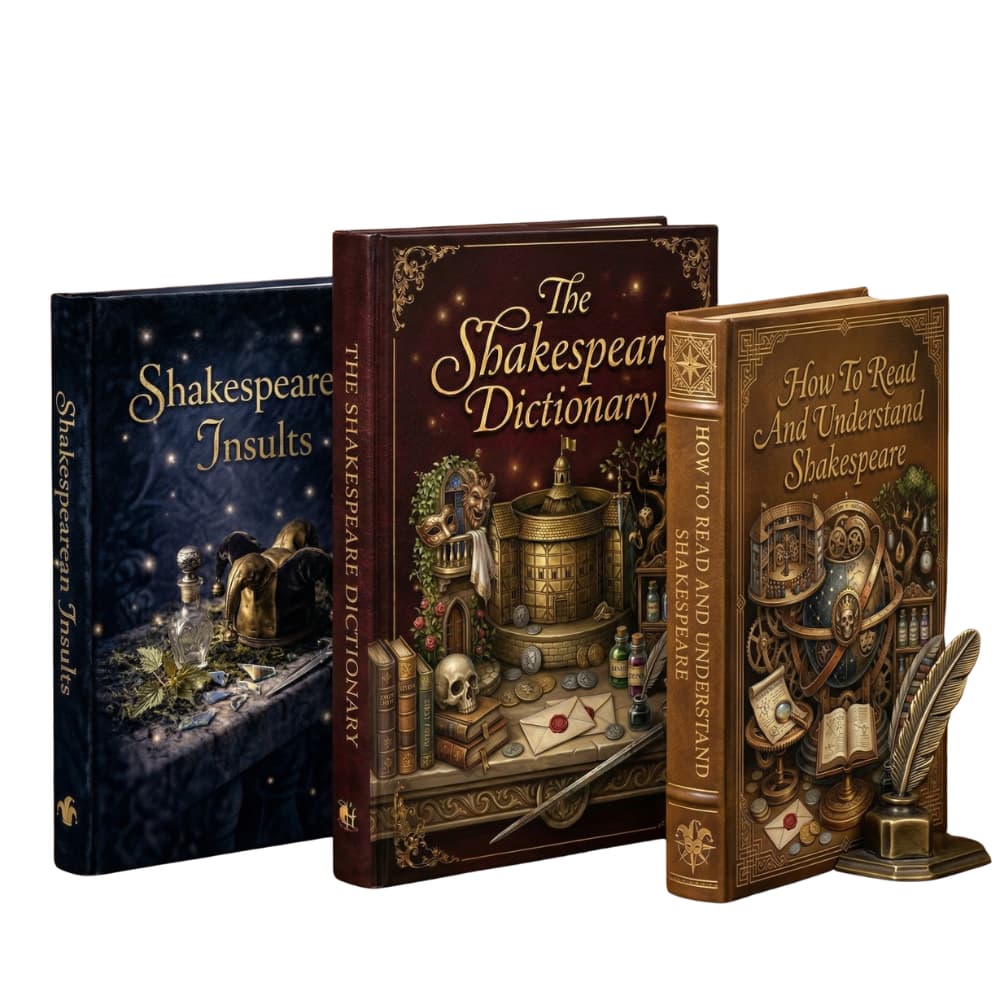
Shakespeare Essentials $19.99
Unlock the wit, wisdom, and world of William Shakespeare with this comprehensive digital bundle.
- How To Read And Understand Shakespeare
- The Shakespeare Dictionary
- Shakespearean Insults
This trio of guides provides everything you need to conquer the Elizabethan era.
Antony And Cleopatra Literary Devices Quiz Questions
- The phrase “Let Rome in Tiber melt” is an example of
- When Enobarbus describes Cleopatra’s barge in lavish imagery, Shakespeare uses
- Cleopatra calling the asp her “baby” is an example of
- The recurring contrast between Rome and Egypt in the play represents
- Antony’s phrase “The hearts that spanieled me at heels” employs
- The line “Age cannot wither her, nor custom stale her infinite variety” features
- When Antony refers to death as “a bridegroom,” it demonstrates
- Cleopatra’s repeated references to “immortal longings” reflect the use of
- Enobarbus’s vivid retelling of Cleopatra’s first meeting with Antony contains
- The contrast between Antony’s noble past and his current weakness is an example of
- When Caesar calls Antony “the abstract of all faults,” Shakespeare uses
- Cleopatra’s manipulation through language reveals Shakespeare’s use of
- Antony’s phrase “my heart was to thy rudder tied” is an instance of
- The Soothsayer’s warnings about Caesar’s fortune employ
- Cleopatra’s line “Give me my robe, put on my crown” employs
- When Antony’s courage contrasts his despair, the device used is
- The phrase “the strong toil of grace” reveals Shakespeare’s use of
- The recurring image of the Nile throughout the play functions as
- Cleopatra’s dream of Antony as “past the size of dreaming” is an example of
- Antony’s phrase “world well lost” demonstrates
- When Enobarbus provides commentary on events unseen by others, Shakespeare uses
- The serpent used in Cleopatra’s death is a central
- Antony’s description of Caesar’s “scarce-bearded Caesar” uses
- When Cleopatra describes her emotions as “thunder in my ears,” the device is
- The repetition of “Rome” and “Egypt” in dialogue serves as
- Cleopatra’s line “Husband, I come” in Act 5 is an example of
- Enobarbus’s ironic loyalty toward Antony creates
- The description of Antony as “a cloud that gathers by the Nile” shows
- Caesar’s calm reaction to Cleopatra’s death demonstrates
- When Antony says “the world shall lose” in reference to his death, it shows