
Shakespeare’s most potent exploration of corrupting power is the tragedy of the Thane of Glamis, from the blasted heath to the high battlements of Dunsinane. This Macbeth Full Book Quiz will test your mastery of the entire story arc, from the first prophecy to the final fall. Show you’re an expert on the Scottish play.

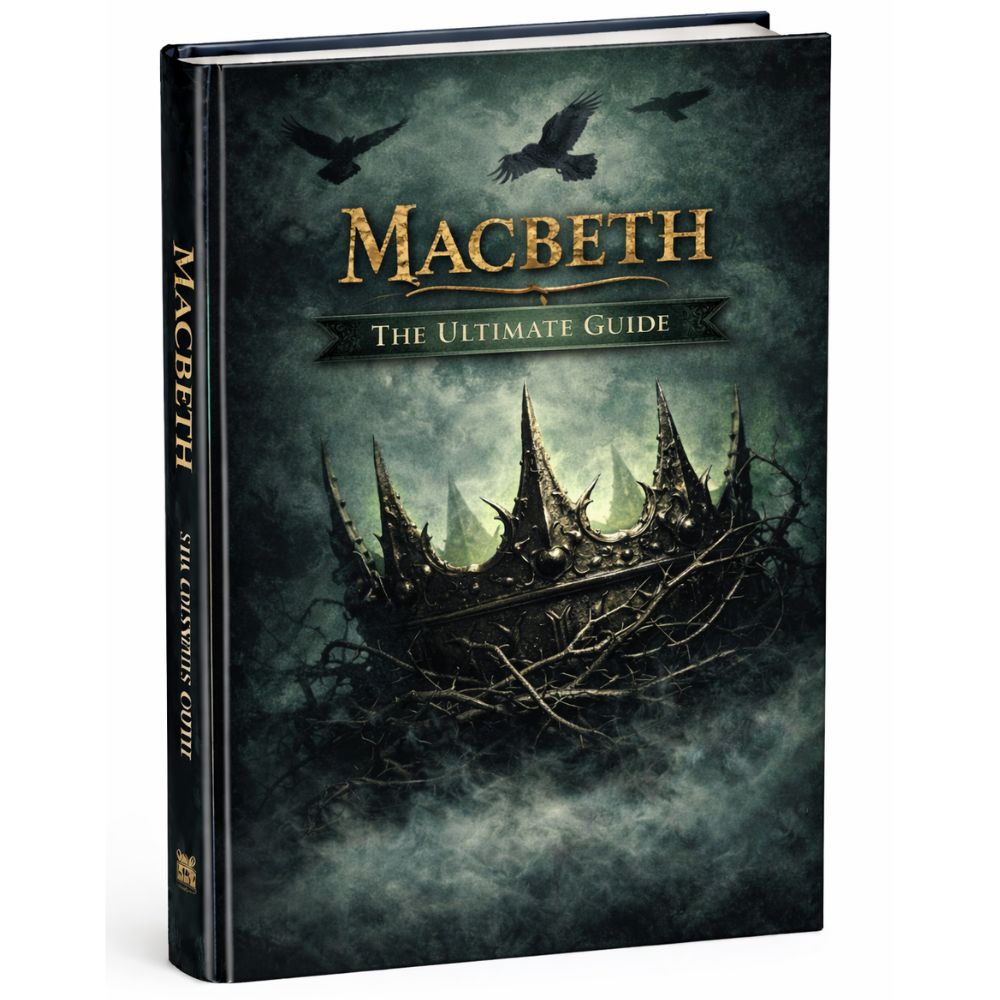
Macbeth | The Ultimate Guide $19.99
Macbeth isn’t just a story about a murder.
It’s a psychological deep-dive into the destruction of the human soul. If you want to stand out, you need to go beyond the surface level.
- 📜 Context That Actually Helps
- ⚠️ Common Traps
- 🩸 Motifs and Symbols
A 50-page masterclass in themes, motifs, and psychological warfare.
Macbeth Full Book Quiz
- Who wrote the tragedy Macbeth
- What country is the setting for most of Macbeth
- Who is the King of Scotland at the beginning of the play
- What title does Macbeth hold at the start of the play
- Who are the first characters to appear in the play
- What prophecy do the witches give to Macbeth
- What prophecy do the witches give to Banquo
- Who tells Macbeth he has become Thane of Cawdor
- What emotion dominates Macbeth after hearing the witches’ prophecy
- Who persuades Macbeth to murder King Duncan
- Where does Duncan’s murder take place
- What does Lady Macbeth say will wash away their guilt
- Who discovers Duncan’s body
- Who are Duncan’s sons
- Where do Duncan’s sons flee after his murder
- Who becomes King after Duncan’s death
- Why does Macbeth order Banquo’s murder
- What happens to Fleance during Banquo’s murder
- What appears to Macbeth at the banquet
- Who tells Macbeth to visit the witches again
- What warning does the first apparition give Macbeth
- What comfort does the second apparition offer Macbeth
- What vision gives Macbeth false confidence
- Who orders the murder of Macduff’s wife and children
- Where does Malcolm raise an army against Macbeth
- What happens to Lady Macbeth in Act 5
- What famous line expresses Macbeth’s despair after hearing of his wife’s death
- Who kills Macbeth
- How can Macduff kill Macbeth despite the witches’ prophecy
- Who becomes King of Scotland at the end of the play
What Kind Of World does Macbeth Step Into?
Scotland stands in a tense moment, shaped by battles, shifting alliances and fragile trust. Macbeth enters this world as a celebrated warrior, steady and dependable. People believe in him and he carries a reputation through loyalty and action. Beneath that strength, something unspoken, a quiet curiosity about power that he tries to ignore. His internal world changes dramatically after the witches appear in act 1 scene 3, offering a prophecy that cracks open possibilities he never allowed himself to consider. When he later speaks with Duncan in act one scene four, ambition sharpens.
The world around him seems to expect greatness and Macbeth begins to listen. Scotland becomes a mirror for his growing in a conflict. It’s uncertainty reflects his desires. It’s instability gives his ambition room to grow. Macbeth steps into a landscape that both shapes him and pushes him towards choices he once will have rejected without hesitation.
How Does Ambition First Take Hold?
The witches spark it, but Macbeth’s own imagination keeps it alive. Their prophecy functions like a doorway into a future. He has not yet earned. At first, he treats the idea with disbelief. Then fascination. Then fear. The shift is quick because ambition often grows fastest in silence.
Macbeth letters to Lady Macbeth reveal how deeply the prophecy has taken route. He wants someone to see what he sees, even if he cannot admit it dire when he returns home, Lady Macbeth recognises the moment with startling clarity. She senses potential and the hesitation that comes with it. Their conversations build tension, pushing Macbeth to pitch the throne with more intensity. The murder in act 2, scene 2, becomes the point where imagination turns into action. From that moment, ambition stops being theoretical. Macbeth crosses a boundary and the play shows how quickly ambition becomes dangerous when paired with fear, pressure and the illusion of opportunity.
Why Does Lady Macbeth Push Him Forward?
Lady Macbeth reads Macbeth more clearly than he reads himself. She recognises his ambition but also the self-doubt that holds it back. Her strength comes from urgency, certainty and the belief the greatness requires bold action. She challenges him, not because she wants chaos, but because she sees a version of Macbeth that she believes is too fearful to become. Her words carry weight and they shape Macbeth thinking in ways he does not fully grasp. When they carry out the plan in act 2 scene 2, the unity appears unbreakable. Yet the aftermath reveals a deep split between them. Macbeth moves towards aggression and secrecy while Lady Macbeth moves toward guilt and emotional collapse.
Her push sets the story in motion, but it becomes the force that leads to her downfall. The strength that drives her early confidence becomes the pressure that destroys her later. Her influence reveals how ambition changes relationships as quickly as it changes identity.
What Happens When Macbeth Claims The Throne?
Once Macbeth takes the crown, fear becomes the driver of every decision. He thought power would secure his future, but instead it exposes every weakness he tried to hide. Being King magnifies his paranoia. He sees threats in every corner, even when none exist. In act 3, he chooses violence as a form of protection convincing himself that removing others will stabilise his rule. His conversation with Lady Macbeth in act 3 scene 2,shows how far he has drifted from her, despite their shared ambition earlier.
Macbeth isolates himself because he believes leadership demands control. At each act of violence pushes him further from the loyalty he once had. Instead of ruling with confidence, he rules with fear. Scotland reflects his decline and the country becomes restless. People whisper and his control loosens even as he tightens his grip. Macbeth discovers that holding a crown is harder than gaining one and the throne becomes the heaviest object he has ever carried.
How Does Guilt Reshape Macbeth and Lady Macbeth?
Guilt becomes a constant presence, shaping every moment after the first murder. Macbeth tries to outpace it with action but guilt follows him into his sleep, his decisions and his relationships. It shows up in visions, sounds and sudden fear appears. Lady Macbeth experiences guilt differently. She suppresses it early using focus and determination to move forward.
Yet guilt does not disappear, it waits and when it finally rises it overwhelms her and her mind becomes a closed room. She cannot escape. Her sleepwalking scene reveals the truth, She tried to avoid. Macbeth, on the other hand tries to numb himself. He convinces himself, Guilt is a weakness that He no longer needs. Yet he’s emotional distance comes with a cost. It removes the last traces of who we used to be. They shared guilt fractures their connection and it creates two separate paths, each shaped by the decision but experienced in opposite ways.
Why Does Macbeth Lose Control Of His Future?
Macbeth loses control because every attempt to secure his power deepens his instability he believes action will solve uncertainty. Each action creates more of it. He trusts the witches again, misreading their messages as promises instead of warnings. His confidence grows even while his world collapses. By the time he reaches act 5 scene 6, Macbeth faces the truth he avoided. His army is shrinking and his allies are gone. The foundation he built has cracked . He fights his last of his strength, but strength alone cannot fix a life built on fear and violence. Macbeth Falls groove the danger of ambition with our boundaries. It shows how person can lose control before they realise it. His end becomes the final consequence of ignoring the limits he wants understood deeply.
What Theme Gives Macbeth Power?
Ambition shapes every moment in the play. It feels desire, fear, violence and regret. Fate appears through the witches, yet choice drives the story forward. Guilt creates emotional weight, forcing characters to confront what they cannot escape. Power becomes a lens that reveals character, exposing qualities that remain hidden in ordinary life. These themes endure because they reflect human behaviour in a way that still feels current. People continue to wrestle with ambition, fear and consequence. Macbeth presents these questions without judgement.
It allows the reader to see the cost of decisions that seem small at first but grow into turning points that define a life. The place power comes from its honesty, simplicity and unfiltered look at choices that cannot be done.
Why Do The Characters Leave Such A Lasting Impact?
Each character carries a clear emotional journey. But Macbeth changes from loyal soldier to fearful ruler. Lady Macbeth transforms from fierce strategist to someone crushed by guilt. Banquo becomes the moral contrast, showing her integrity responds to temptation. MacDuff becomes the force of justice, acting with clarity rather than ambition. These characters shape the story because they reflect different responses to pressure, prophecy and desire their actions feel human even when they become extreme. Shakespeare presents them without heavy explanation.
Their choices speak for them. This simplicity allows readers to connect with the motivations and failures. The characters stay with you because they are real human contradictions, revealing strength and weaknesses that exist in every era.
How Does Macbeth Expand Your Understanding Of Language?
Shakespeare builds Macbeth with language that exposes emotion through rhythm. language creates tension and atmosphere long before characters act on their desires. Studying the vocabulary within the play reveals how short lines hit with precision, shifting through tone, metaphor, and emphasis, while longer lines express conflict. The rhythm mirrors Macbeth’s emotional landscape, moving from steady clarity to relentless intensity. Readers who explore the language more deeply find layers that reveal while the play remains powerful.
Macbeth rewards attention, showing how carefully chosen words can carry fear, ambition, desire, and guilt with striking simplicity.