
Do you know your shrift from your coxcomb or why a palmer would be at a party? This Romeo And Juliet Vocabulary Quiz will separate the casual readers from the true scholars. Deciphering the Elizabethan tongue is a must! Define the terms that make the play live.

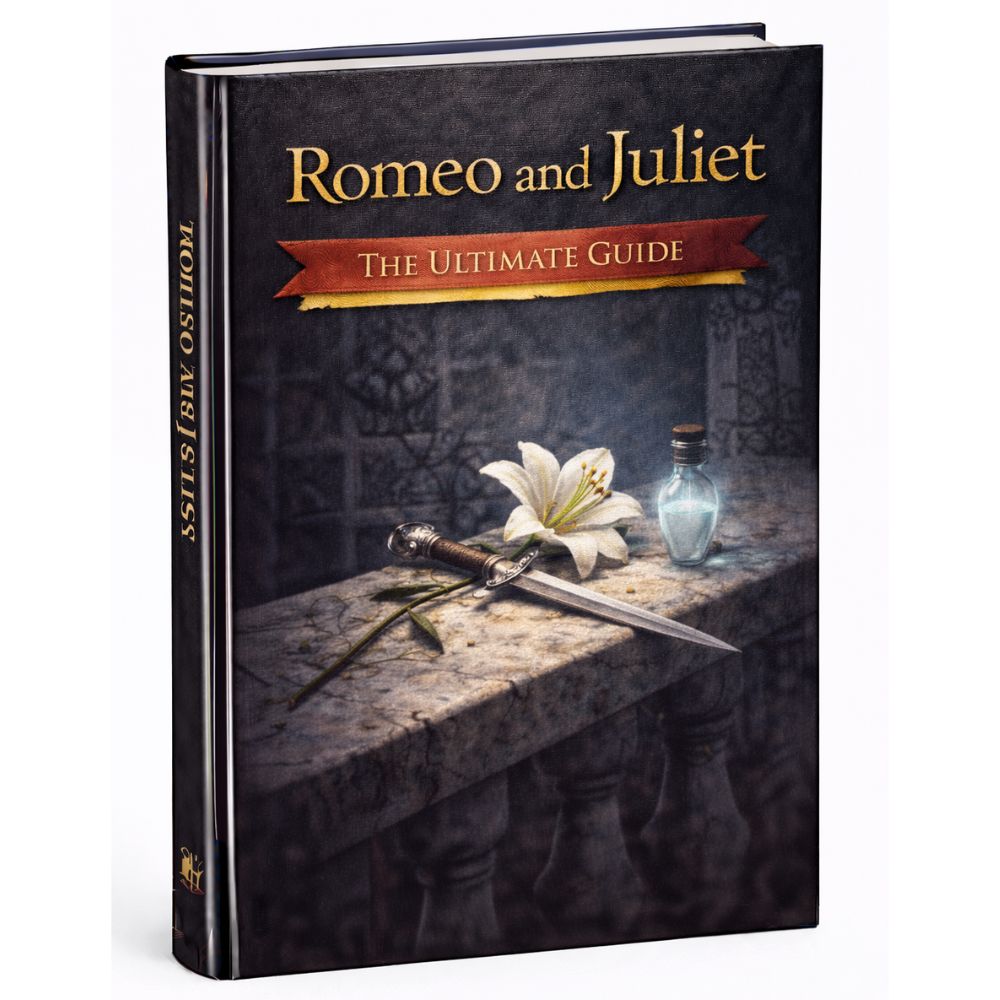
Romeo and Juliet | The Ultimate Guide $19.99
We’ve distilled decades of academic scholarship into a high-density toolkit designed specifically for the modern exam.
- 🗣️ The Rhetoric Toolkit
- 🗺️ Relationship Mapping
- ⚖️ Power & Status Matrix
A 50-page masterclass in themes, motifs, and dramatic irony.
Romeo And Juliet Vocabulary Quiz Questions
- What does “banished” mean when Romeo laments his punishment?
- What does “fain” mean when Juliet says “Fain would I dwell on form”?
- What does “woe” mean in “For never was a story of more woe”?
- What does “jest” mean when Mercutio teases Romeo?
- What does “vexed” mean in the play’s emotional exchanges?
- What does “betimes” mean when used in directions to act early?
- What does “dote” mean when used to describe Romeo’s feelings?
- What does “villain” mean when Tybalt insults Romeo?
- What does “confines” mean when Prince Escalus refers to Verona’s boundaries?
- What does the word “choler” mean in the play?
- What does “wherefore” mean when Juliet says “Wherefore art thou Romeo”?
- What does “anon” mean when characters call for someone?
- What does “farewell” mean in Shakespearean English?
- What does “hie” mean when Friar Lawrence tells Romeo to hurry?
- What does “thou” mean in the dialogue?
- What does “thee” mean when a character speaks affectionately?
- What does “thy” mean in phrases like “Thy father and thy name”?
- What does “thine” mean when used before a vowel sound?
- What does “hence” mean when characters are banished?
- What does “whence” mean in the line “Whence came you?”
- What does “soft!” mean when used by Romeo in “But soft, what light through yonder window breaks?”
- What does “woo” mean when Paris seeks Juliet’s hand?
- What does “foe” mean in “From forth the fatal loins of these two foes”?
- What does “beseech” mean in Shakespearean language?
- What does “tis” mean in the phrase “’Tis the nightingale and not the lark”?
- What does “ere” mean when used by Juliet as “ere one be gone”?
- What does “hark” mean when a character says it suddenly?
- What does “art” mean when Friar Lawrence says “Thou art wedded to calamity”?
- What does “aught” mean in the phrase “If thou dost love me, say it not in aught but truth”?
- What does “naught” mean in Shakespearean dialogue?